
Radiant Comfort
In-Floor Heating Installation In Oakville
Hydronic radiant in-floor heating for new builds, additions and bathroom renovations. Quiet, dust-free, evenly warm, designed for the way Halton homes actually live.
Hydronic radiant in-floor heating for new builds, additions and bathroom renovations. Quiet, dust-free, evenly warm, designed for the way Halton homes actually live.
Walk into a house with a properly designed in-floor system and you can usually feel it before you see the thermostat. No air rushing out of vents, no cold spots near the windows, no rooms ten degrees apart. Just an even, comfortable warmth coming up from the floor.
At IKAD Mechanical, we design and install hydronic in-floor heating systems for homeowners and builders across Halton. We've put radiant in everything from a single bathroom retrofit in an Oakville bungalow to a fully zoned 6,000 sq.ft. custom home in Milton.
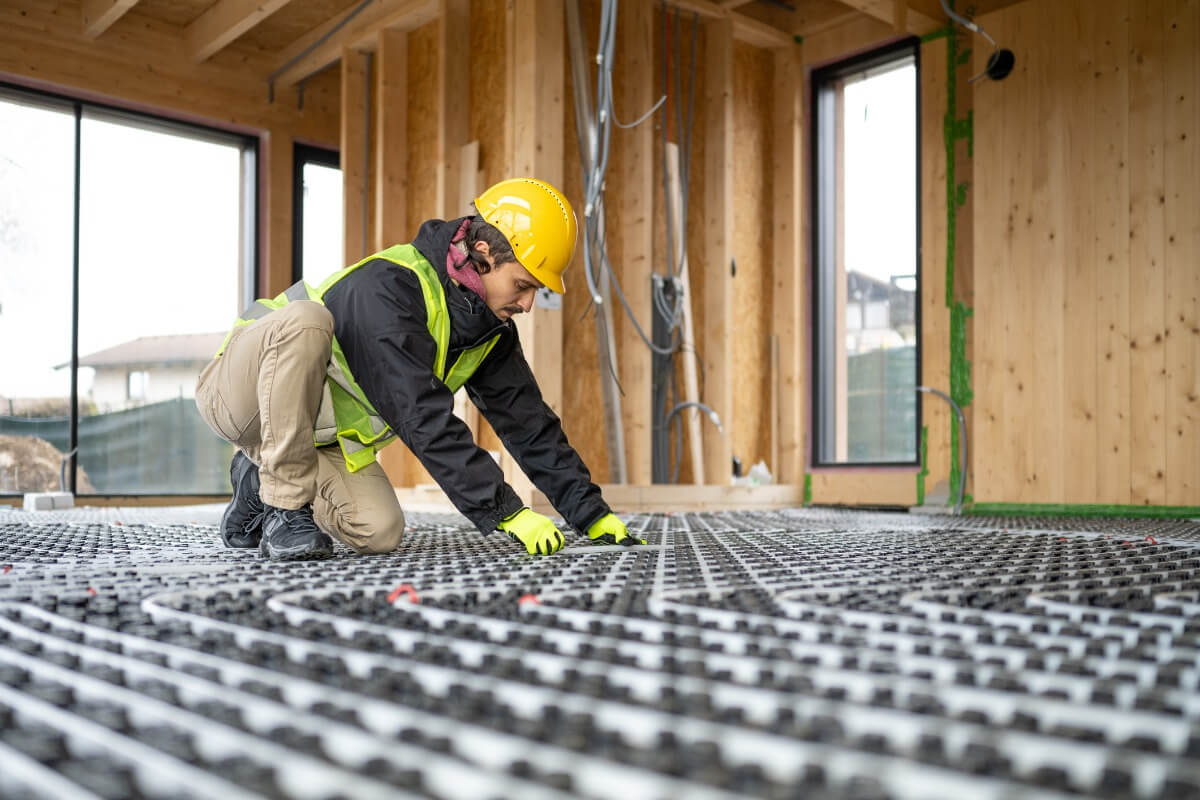
We embed PEX tubing in the floor, either set into a concrete slab on grade, on top of subfloor in a thin lightweight pour, or stapled up between joists from below. A boiler or condensing combi-unit heats water to roughly 38–45°C and circulates it through the loops. Manifolds with zone valves let each room or area run at its own temperature.
Even temperatures wall-to-wall. No ductwork pushing dust and allergens. No noisy blower. Floors that are warm in the winter. Lower operating cost than electric heat. And it pairs beautifully with high-efficiency condensing boilers, you can run a 32°C supply temperature and still keep a 22°C house, which is where boilers hit their best efficiency.
The biggest performance difference between a good and a great in-floor system is zoning. Most Halton custom homes we work on use 3 to 7 hydronic zones with individual thermostats: main floor, basement, master ensuite, kitchen, second-floor bedrooms separately if possible. Manifolds with zone valves (Taco, Watts) let each space hold its own setpoint. A bedroom kept at 18°C overnight saves real money compared to one shared loop forcing the whole house to 21°C.
Tile and stone are the ideal surfaces for radiant: high thermal mass, fast response, no insulation between the heat source and your feet. Engineered hardwood works fine if you keep the supply water below 38°C and let the floor acclimate slowly during the first heating season. Solid hardwood and carpet over radiant are riskier: carpet acts as an insulator that requires hotter supply water (efficiency penalty), and solid hardwood can cup or gap if temperatures spike. We design the loop spacing and supply temperature to match your final flooring choice.
Hydronic in-floor heats slowly. A typical 4-inch concrete slab takes 4 to 6 hours to come up to temperature after a setback. That makes a smart thermostat with predictive recovery (Ecobee Premium or a dedicated hydronic controller like tekmar) genuinely useful here, where it'd be marginal on forced air. We program the schedule against typical Halton sleep and work patterns and tune it through the first heating season.
In-floor heating available in: Oakville · Burlington · Milton · Halton Hills · Mississauga · Hamilton · Brampton
Our trucks roll out of our Oakville shop and reach across the western GTA. Tap any city for local details, response time, permit office, neighbourhoods, and city-specific FAQs.
For new construction, hydronic in-floor adds roughly $14–$22 per square foot when you include the boiler and manifolds, so a 600 sq.ft. main-floor zone runs about $10,000–$13,000. Bathroom-only electric mat retrofits start around $1,400 installed (tile and substrate not included). It's commonly paired with a custom-home mechanical package for whole-home zoning.
It can, but in most Halton homes we recommend pairing it with a small forced-air system for cooling and HRV ventilation, since you can't run AC through floor loops. Whole-home hydronic with a separate ductless mini-split for cooling is a popular combination.
PEX tubing in a properly poured slab will outlive the house, 50+ years. The wear parts are the boiler (15–20 years), the circulator pumps (10–15 years) and the zone valves (15+ years). All are easily serviced without disturbing the floor. Pair with a condensing combi unit to do both DHW and heat from one boiler.
Yes, two ways. Above the subfloor with a thin lightweight pour (raises floor height ~1.5 inches), or below in joist bays as a staple-up system (no floor height change but slightly lower output). Bathrooms are the easiest retrofit, basement slab is harder unless you're already redoing the floor. We service all of Halton Region for in-floor retrofits.